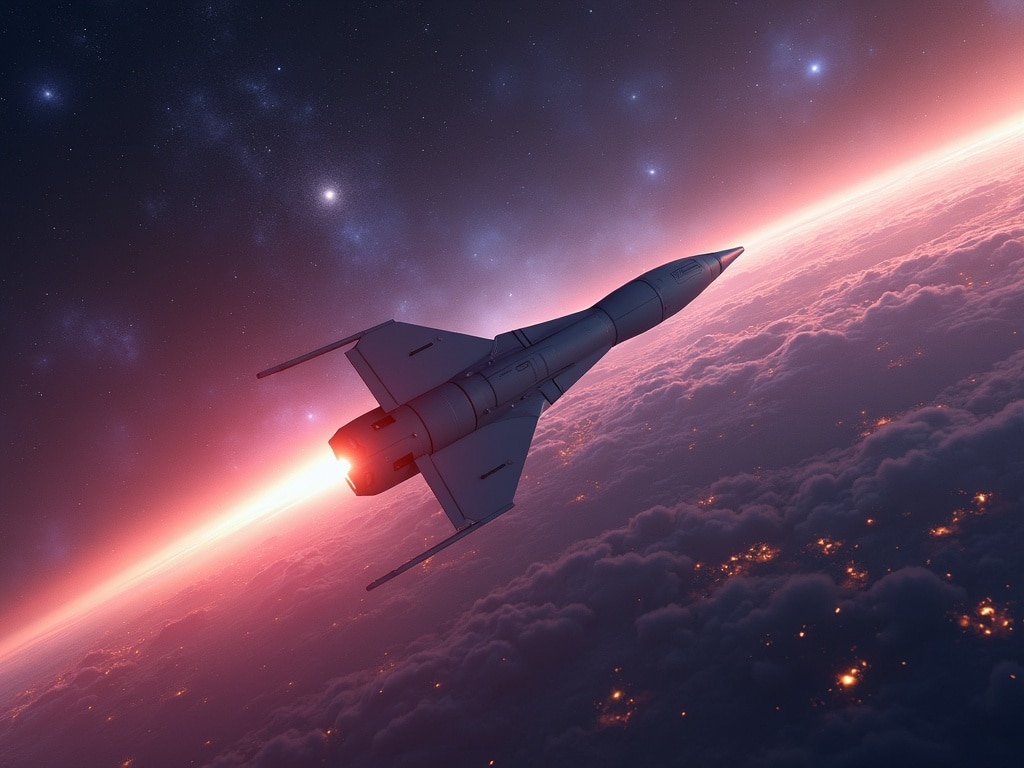
SpaceX Starship: The Interplanetary Revolution is HERE!
History and Development of Starship
The journey of Starship began with a series of ambitious concepts and prototypes. Initially known as the Mars Colonial Transporter (MCT), the project’s scope broadened over time, evolving into the grand vision of a versatile, fully reusable space vehicle. Early iterations, like the Starhopper, were ungainly but crucial steps, demonstrating the radical belly flop landing technique now synonymous with Starship. Through numerous test flights, both successful and explosive, SpaceX refined the design, materials, and engine technology – particularly the groundbreaking Raptor engine – gradually transforming Starship from a concept into a tangible, testable reality. Every fiery mishap and triumphant hop has provided invaluable data, pushing the boundaries of aerospace engineering and bringing interplanetary travel closer to realization.
Starship’s Design and Technical Specifications
Starship is a two-stage-to-orbit, fully reusable system. The first stage, known as Super Heavy, is a massive booster powered by an array of Raptor engines. The second stage, also called Starship, is the crew and cargo-carrying spacecraft that sits atop Super Heavy. Both stages are designed for rapid reusability, a key factor in reducing the cost of space travel. Starship itself is constructed from stainless steel, chosen for its strength, durability, and cost-effectiveness. Its sleek, futuristic design incorporates heat shielding for atmospheric reentry and large flaps for controlled descent.
Here’s a quick look at some key specs:
- Height (with Super Heavy): Approximately 120 meters (394 feet)
- Diameter: 9 meters (30 feet)
- Payload Capacity: Over 100 metric tons to Earth orbit
- Engines (Super Heavy): Up to 33 Raptor engines
- Engines (Starship): 6 Raptor engines (3 sea-level optimized, 3 vacuum-optimized)
Key Differences Between Starship and Other Rocket Systems
Starship isn’t just bigger or more powerful; it represents a fundamental shift in how we approach space travel. Here’s how it stacks up against traditional rockets:
- Full Reusability: Unlike most rockets, which are partially or entirely expendable, Starship is designed for complete and rapid reuse, significantly lowering launch costs.
- Massive Payload Capacity: Starship can carry far more cargo and crew than existing rockets, enabling large-scale space missions and colonization efforts.
- Versatility: Starship is designed for a wide range of missions, from launching satellites to transporting humans to Mars, making it a highly adaptable platform.
- On-Orbit Refueling: Starship is designed to be refueled in Earth orbit, extending its range and enabling trips to distant destinations like the Moon and Mars.
These innovations combine to create a system that promises to revolutionize access to space, making it cheaper, more frequent, and more accessible.
Starship’s Capabilities and Potential Applications
Starship’s potential applications are as vast as space itself. Beyond its primary goal of enabling human missions to Mars, Starship can:
- Deploy next-generation satellites: Its large payload capacity allows for the deployment of massive communication and observation satellites.
- Enable lunar missions: Starship can transport astronauts and cargo to the Moon, paving the way for sustained lunar exploration and resource utilization.
- Conduct scientific research: Its spacious interior can accommodate a wide range of scientific experiments in microgravity.
- Facilitate space tourism: Starship could offer suborbital and orbital spaceflights to paying customers, democratizing access to space.
- Provide rapid point-to-point transportation on Earth: Imagine traveling from New York to Tokyo in under an hour! Starship could potentially revolutionize long-distance travel on Earth.
The possibilities are truly limitless, and as Starship’s capabilities continue to evolve, even more applications will emerge.
Starship’s Role in Space Exploration and Colonization
Starship is not just about getting to Mars; it’s about establishing a permanent human presence beyond Earth. Elon Musk, the founder of SpaceX, envisions a self-sustaining Martian colony as a crucial step in safeguarding humanity’s future. Starship is the key to making this vision a reality, providing the means to transport the necessary resources, equipment, and people to build a thriving civilization on the Red Planet. This includes:
- Construction Materials: Transporting habitats, rovers, and other infrastructure.
- Life Support Systems: Delivering equipment for water extraction, oxygen production, and food cultivation.
- Personnel: Carrying the engineers, scientists, and pioneers who will build and maintain the Martian colony.
By enabling large-scale colonization efforts, Starship aims to transform humanity into a multi-planetary species, reducing our vulnerability to existential threats and opening up new frontiers for exploration and discovery.
What are the Major Technological Challenges Starship Faces?
While Starship has made tremendous progress, significant technological hurdles remain. These challenges include:
- Raptor Engine Reliability: Ensuring the Raptor engines can withstand the rigors of repeated launches and landings. Continuous improvements are being made to increase engine durability and performance.
- Heat Shielding: Developing a robust and reliable heat shield to protect Starship during atmospheric reentry. The current hexagonal tile system is complex and requires careful maintenance.
- On-Orbit Refueling: Perfecting the process of transferring propellant between Starships in orbit, a critical capability for long-duration missions. This requires precise control and coordination.
- Super Heavy Landing: Successfully landing the Super Heavy booster after separating from Starship. This is a complex maneuver that requires precise control of the booster’s engines and grid fins.
Overcoming these challenges will require further innovation, testing, and refinement. But with each successful test flight, SpaceX is steadily moving closer to solving these complex engineering problems.
What is the Launch Process of Starship?
The launch of Starship is a spectacle of engineering prowess. Here’s a simplified overview of the process:
- Stacking: The Starship spacecraft is mounted atop the Super Heavy booster.
- Ignition: The Raptor engines on the Super Heavy booster ignite, generating millions of pounds of thrust.
- Liftoff: Starship ascends from the launchpad, propelled by the immense power of its engines.
- Stage Separation: After a few minutes of flight, the Super Heavy booster separates from the Starship spacecraft.
- Super Heavy Landing: The Super Heavy booster returns to Earth for a controlled landing, either back at the launch site or on a designated landing platform.
- Starship Ascent: The Starship spacecraft continues its journey to orbit, powered by its own Raptor engines.
- Mission Execution: Once in orbit, Starship performs its designated mission, whether it’s deploying satellites, conducting research, or traveling to the Moon or Mars.
- Reentry and Landing: Upon completion of its mission, Starship reenters the Earth’s atmosphere, using its heat shield to protect itself from the intense heat. It then performs a controlled descent and landing using its flaps and engines.
While seemingly straightforward, each step involves intricate maneuvers and precise control, requiring the seamless coordination of hardware and software.
What is the Starship Program’s Current Status and Future Milestones?
The Starship program is currently in an intensive testing phase. SpaceX is conducting frequent static fire tests and flight tests of both the Starship spacecraft and the Super Heavy booster. These tests are crucial for gathering data, identifying areas for improvement, and pushing the boundaries of what’s possible. Key milestones on the horizon include:
- Orbital Flight Test: Achieving a successful orbital flight of the fully integrated Starship and Super Heavy system.
- On-Orbit Refueling Demonstration: Demonstrating the ability to transfer propellant between Starships in orbit.
- Uncrewed Lunar Landing: Landing a Starship spacecraft on the Moon without crew.
- Crewed Lunar Mission: Transporting astronauts to the Moon and back.
- Uncrewed Martian Mission: Sending a Starship spacecraft to Mars to scout out landing sites and prepare for future human missions.
- Crewed Martian Landing: Landing humans on Mars and establishing a permanent base.
These ambitious milestones represent a long-term vision for the future of space exploration, and SpaceX is committed to achieving them through relentless innovation and testing.
Starship’s Environmental Impact and Sustainability
While Starship promises to revolutionize space travel, it’s important to consider its potential environmental impact. Concerns include:
- Emissions: The Raptor engines burn methane and liquid oxygen, producing carbon dioxide and water vapor. While cleaner than some rocket fuels, these emissions still contribute to greenhouse gas concentrations.
- Noise Pollution: The immense noise generated by Starship launches can disrupt wildlife and impact nearby communities.
- Orbital Debris: The increasing number of satellites and spacecraft in orbit raises concerns about space debris, which can pose a threat to operational satellites and spacecraft.
SpaceX is actively working to mitigate these impacts by exploring sustainable fuel alternatives, implementing noise reduction measures, and developing strategies for debris removal. The long-term goal is to make space travel as environmentally friendly as possible.
How Does Starship Affect the Space Industry and Economy?
Starship has the potential to disrupt the space industry and create new economic opportunities. By drastically reducing the cost of access to space, Starship could:
- Enable new commercial ventures: Lower launch costs could spur the development of new space-based businesses, such as satellite manufacturing, space tourism, and asteroid mining.
- Drive innovation: Starship’s advanced technologies could lead to breakthroughs in materials science, propulsion systems, and other areas.
- Create jobs: The expansion of the space industry could create new jobs in engineering, manufacturing, and related fields.
- Expand our understanding of the universe: More frequent and affordable space missions could lead to new discoveries about the cosmos and our place in it.
Starship represents a bold vision for the future of space exploration and a potential catalyst for economic growth and innovation.
Conclusion
SpaceX’s Starship is more than just a rocket; it’s a symbol of human ambition and a testament to the power of innovation. It promises to reshape our relationship with the cosmos, opening up new frontiers for exploration, colonization, and discovery. While challenges remain, the progress made thus far is truly remarkable. Whether you dream of walking on Mars, witnessing the Earth from orbit, or simply marveling at the ingenuity of humankind, Starship offers a glimpse into a future where the boundaries of space are no longer a barrier, but a gateway to infinite possibilities. The interplanetary revolution is not just coming; it’s HERE!